
What structured data actually does
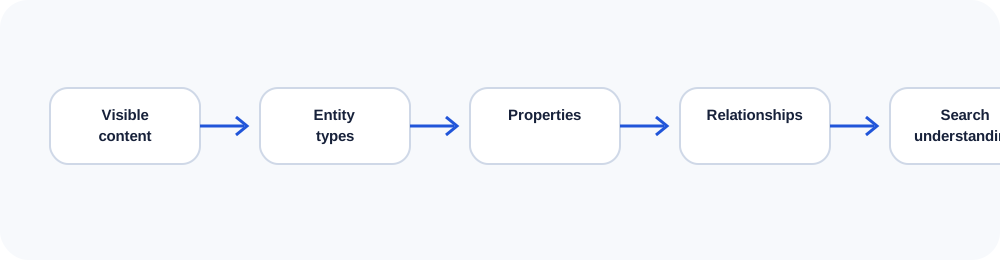
Structured data is a machine-readable description layered on top of visible content. It gives search systems an explicit vocabulary for identifying a business, person, service, article, event, product or breadcrumb trail. It does not replace ordinary page content, and it does not guarantee a rich result. Its value is clarity: a well-formed graph can show that a service belongs to an organization, that an author wrote an article, and that a page occupies a specific place in the site hierarchy.
In practice, this means documenting the decision, assigning ownership and checking the result after launch. The details vary by project, but the principle remains the same: make the system understandable enough that another qualified person can maintain it without guessing.
Entities, properties and relationships
An entity is a distinct thing: WebForLess, a specific service, a guide, a person or a location. Properties describe the entity, while identifiers connect references to the same thing. Stable @id values are especially useful because several nodes can point to one organization instead of repeating slightly different versions of it. This creates a coherent graph rather than a pile of isolated blocks.
In practice, this means documenting the decision, assigning ownership and checking the result after launch. The details vary by project, but the principle remains the same: make the system understandable enough that another qualified person can maintain it without guessing.
Choosing the right schema type
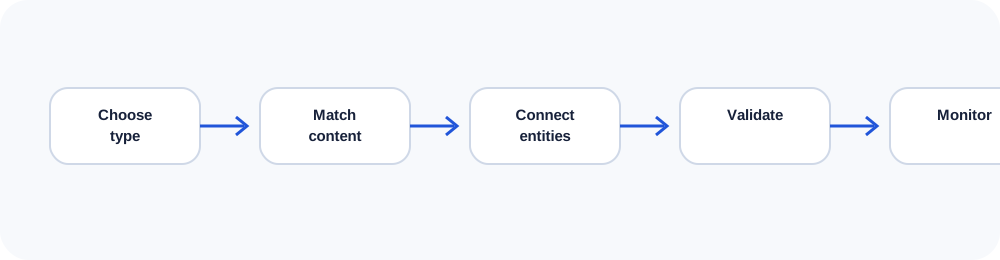
The most specific accurate type is usually better than a vague one, but specificity must remain truthful. Organization and WebSite provide the site-wide foundation. WebPage, Article, Service, BreadcrumbList, Person, LocalBusiness and Product may apply on particular pages. FAQPage should only be used when the questions and answers are visibly present. Review and rating markup needs special care because search platforms restrict when self-serving ratings are eligible.
In practice, this means documenting the decision, assigning ownership and checking the result after launch. The details vary by project, but the principle remains the same: make the system understandable enough that another qualified person can maintain it without guessing.
JSON-LD and page architecture
JSON-LD keeps structured data separate from the visual HTML while allowing rich relationships. A graph can identify the publisher, website, page, breadcrumb, service and FAQ content in one script. The markup should use the canonical URL, match the page language, and avoid duplicate nodes with conflicting names or descriptions.
In practice, this means documenting the decision, assigning ownership and checking the result after launch. The details vary by project, but the principle remains the same: make the system understandable enough that another qualified person can maintain it without guessing.
Validation and maintenance
Syntax validation only proves that the JSON parses. Semantic review asks whether the type is appropriate, required properties are present, URLs resolve, and claims match the page. After deployment, monitor search-console reports and re-test after templates or content change. A valid block can become inaccurate when the visible page is redesigned.
In practice, this means documenting the decision, assigning ownership and checking the result after launch. The details vary by project, but the principle remains the same: make the system understandable enough that another qualified person can maintain it without guessing.
Structured data and AI search
Answer systems benefit from explicit entities and relationships, but schema alone does not make a page authoritative. Clear definitions, evidence, citations, consistent naming, useful headings and accessible HTML still matter. Structured data supports interpretation; it cannot compensate for thin or unreliable content.
In practice, this means documenting the decision, assigning ownership and checking the result after launch. The details vary by project, but the principle remains the same: make the system understandable enough that another qualified person can maintain it without guessing.
Use the companion workbook
Turn the ideas in this lesson into a documented audit, decision or implementation plan.
Frequently asked questions
Does schema improve rankings?
Schema can improve understanding and eligibility for supported features, but it is not a guaranteed ranking boost.
Can every page use FAQ schema?
Only use FAQPage when the complete questions and answers are visible on the page and the implementation follows current search-platform policies.
Should I use Microdata or JSON-LD?
JSON-LD is generally easier to maintain because it separates the graph from the visual markup.
How often should schema be reviewed?
Review it after template changes, rebranding, service changes, URL migrations and major content updates.
Can schema include information not shown on the page?
Avoid hidden claims. Important statements should be supported by visible content or reliable connected data.
Continue learning
Use the next guide, an interactive tool or the related service page to turn this lesson into a practical decision.